


In the Eastern European vintage automotive realm, it is easy to incorrectly assume that all of the cars are basically Russian. And that kind of assumption, especially today, can bring with it some heavy, negative baggage. So let’s turn instead, and quite consciously, to the cars produced by the other former Soviet Republics. Specifically, the “Zaporozhets” produced by ZAZ in what was then the Soviet Republic of Ukraine.
The ZAZ Zaporozhets were a series of Ukrainian automobiles produced by the Zaporozhsky Avtomobilny Zavod (ZAZ) from 1960 to 1994. Because the models were numbered and not named, the cars of the series are often referred to as simply “Zaporozhets” or “ZAZ.” The Zaporozhets, both the first and second generation, were small, compact cars that became one of the most iconic vehicles in the Soviet Union.
From Soviet Icon to Automotive Quirk
The first Zaporozhet, the 965 models, were only produced from 1960 to 1969. With the prototyping done by Moskvitch, the engine coming from NAMI, and the Ukrainian auto maker LuAZ pushing for the relatively advanced four-wheel independent suspension, it was very much a Soviet project directed from the centralized automotive ministry, Minavtroprom.
This first generation had an air-cooled, rear-mounted, V4. With a magnesium block and 746cc displacement, the V4 produced an unimpressive 23 hp. It may look like another Fiat licensed socialist car, but this was definitely a product of home-grown, Soviet engineering.
Most importantly, though, the Zaporozhets had “ушки” (ushki).
The rear-engine design of the Zaporozhets required efficient air circulation to prevent the engine from overheating. To keep the V4 cool, the 965 design integrated air intake grills on the rear quarter panels of the car helped draw in cool air while the vehicle was in motion.
This noticeable feature set the Zaporozhets apart from other city cars and added to the distinct character of the plucky little car. The popularity of this design feature is evident in the affectionate nickname for the vents- ushki – meaning “ears” in Russian.
The “ears” on the Zaporozhets became one of its recognizable design elements. The ears added to the unique and somewhat quirky appearance of the car, making it easily distinguishable from other vehicles on the road. It was immediately apparent it wasn’t Italian.
Features and Innovations of the ZAZ-966 and ZAZ-968
To the Western world, the ZAZ 965’s biggest claim to fame might be in being one of the worst Bond cars in the franchise. In the 1995 James Bond movie, Goldeneye, the decrepit, tiny vehicle that the Moscow CIA contact drives is a pale blue ZAZ 965, with its distinctive little ears letting you know that it’s not just another Fiat. In terms of car casting in the movie, it underscores the drab, low-tech Soviet state and diminishes the CIA agent given Bond’s history of Lotuses, BMWs and, of course, Aston Martins.
Since the first generation ZAZ was immortalized in film, it tends to overshadow its successor in the Western mind. But that plucky little 965 was to be replaced by a very different and very much better looking design beginning in 1966.
These two very different Zaporozhets do share one other trait beyond their manufacturer that merits them being discussed in the same breath; they both sport those distinctive ushki.
The ears on the second generation are just cooler, though. In the second generation 966 and 968 styling, the ‘ears’ have become jet-aged air scoops reminiscent of fighter planes, complete with chrome leading edges.
The entire look of the 966 was a departure from the 965. The entire redesign was done by the Ukrainian ZAZ and the result was a larger, two-door notchback saloon. If the first generation reminded people of the Fiat 600, the second generation was more of a Chevrolet Corvair combined with a jet. Both the 966 and 968 had the same body lines and so are considered together as the second generation of the Zaporozhets.
I’ll let these photos speak for themselves.
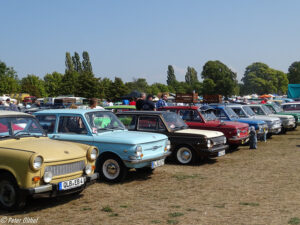
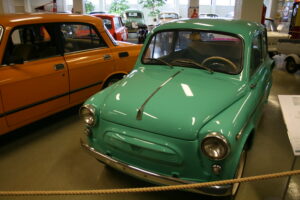
The ZAZ-966, also known as the Zaporozhets-2, was introduced in 1966. It retained the compact size and rear-engine layout of the original Zaporozhets. The ZAZ-968, also known as the Zaporozhets-3, was introduced in 1971. It represented further improvements and refinements such as increased engine power from a larger 1.2l motor; upgraded interior with revised dashboard layout and improved seating comfort; enhanced safety features including a padded dashboard, three-point seat belts, and improved lighting; and further refined suspension improving the ride over previous models.
While the Zaporozhets gained popularity within the Soviet Union, it was not widely exported to other countries. However, a small number of Zaporozhets cars found their way to various countries, including some in Eastern Europe, Asia, and even North America.
Despite its popularity, the ZAZ Zaporozhets faced criticism for certain aspects, such as its lack of advanced features, limited performance, and outdated design. Over time, it became less competitive in the market, and production eventually ceased in 1994.
In 1979, the 968M became the last and longest running ZAZ iteration in production. Despite interior modernization and a choice of motors tailored to different fuel octane, this last version fell victim to simplification and streamlining- in short, the 968M had its ears clipped. The air cooling was handled by louvered hood lid and rear quarter panels instead of side scoops. Without the distinctive ushki, it’s hard to spot this last conformist ZAZ in a crowd. It lost its character, and it lost its jet set style.
The title referenced only two Zaporzhets, which is technically correct, but the 968M is both its own ZAZ iteration and undeserving of the title ‘Zaporozhets’ because it lacks the defining ushki. Of the three iterations of the Zaporozhets – the 965 Bond car, the 966/968 jetstream saloon and the pedestrian, ushki-less 968M – the jet stream saloon is the most evocative.
Nevertheless, the ZAZ Zaporozhets remain an important part of automotive history, representing an era of Soviet Ukraine automobile manufacturing and the aspirations for an affordable and accessible car for the masses. It continues to be cherished by collectors and enthusiasts around the world.
Slava Ukrayini!